
DISCOWEEK WEBRADIO
Visual
Ready to Disco Press Tune In

Last Played Tracks

DISCOWEEK Sonic Signatures / Clubs
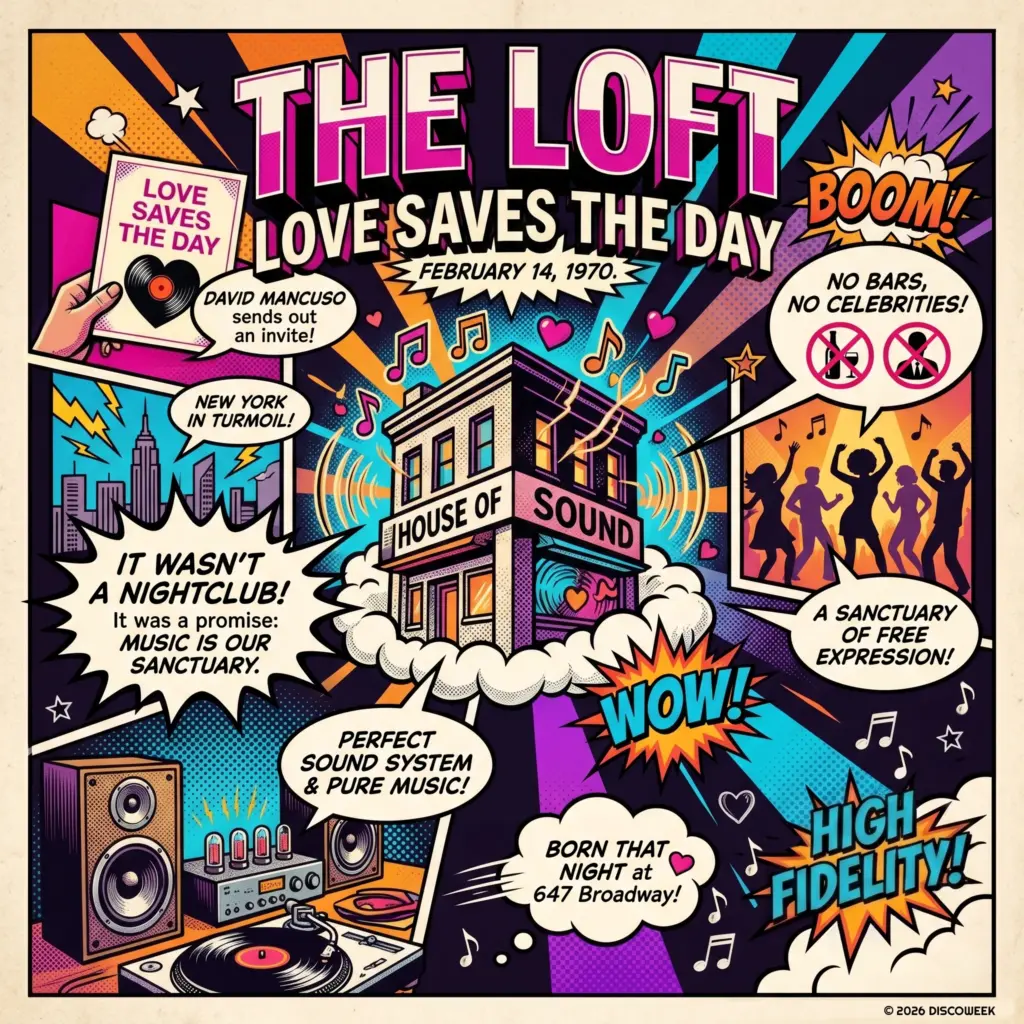
THE LOFT / February 14, 1970. New York is in turmoil, but at 647 Broadway, David Mancuso sends out an invitation that will change history: “Love Saves The Day”. Here, in his own loft, there are no bars, no celebrities, just a perfect sound system and a promise: music is our sanctuary. The Loft was born that night. It wasn’t a nightclub; it was a revolution of love and high fidelity.
STUDIO 54 : The temple of all possibilities. At Studio 54, the party becomes a total performance.
Here, social hierarchies explode under the spotlights. It is a feverish sanctuary, where Andy Warhol’s silent gaze meets the raw magnetism of Liza Minnelli and Grace Jones. This is the only stage where Bianca Jagger could ride a white horse through a sea of legends, where Halston drapes the world in silk, and where David Bowie, Michael Jackson, and Elizabeth Taylor share the same neon-lit air. From the street-smart hustler to the fashion elite, everyone is a star under the silver moon. Between scandals and glitter, Disco reaches its media peak. It’s the place everyone wanted to enter… but only the boldest survived the night.
THE WAREHOUSE / Chicago, 1977.
In an old warehouse, Frankie Knuckles reinvents Disco.
He slows the tempo, hardens the bass: The Warehouse gives its name to ‘House Music’.
This is where the genre mutates, becoming darker, more physical, never to stop again.
THE HACIENDA / Manchester, 1982.
The Haçienda is a laboratory. Designed like a factory, this club bridges the gap between Munich Disco and tomorrow’s Rave culture. Under the steel beams, the future is written in yellow and black. It’s the final stop before Disco becomes a global electronic blast.

THE PARADISE GARAGE / 84 King Street. A former parking garage becomes the cathedral of rhythm. Here, Larry Levan doesn’t just play records; he conducts a ceremony. The sound is so pure it vibrates through your very soul. At the Paradise Garage, Disco grows darker, deeper, more radical. This is the birthplace of the ‘Garage’ spirit: a total devotion to music, where the dancefloor is a sanctuary and the DJ, its prophet.
LE PALACE / Paris has its own kingdom: Le Palace. Fabrice Emaer mixes the elite with the underground. In this converted theater, fashion and intellect lose themselves on the dancefloor. It’s the epicenter of the original French Touch, dancing on a volcano of elegance and decadence.
REX CLUB / Boulevard Poissonnière. Beneath the neon signs of the cinema, a revolution is brewing in the basement. This isn’t just a club; it is a subterranean force, a dark engine whose influence vibrates across the globe, redefining the very pulse of electronic music. Here, Laurent Garnier writes the manual for the French Touch, transforming this concrete box into a sanctuary for the world’s greatest sound-scientists. This is the crucible where Carl Cox commands the floor with raw energy, where Daft Punk first tests the unpolished grit of ‘Homework,’ and where a young David Guetta finds the true, pulsing soul of House music. Inside these walls, Jeff Mills carves the future in black and white with surgical precision, while the distorted fire of Justice, Vitalic, and Miss Kittin sparks a new electric era. No VIPs, no mirrors—just the sound. The Rex remains the bastion of the underground, where Paris learned that the future of Disco… was a machine that never sleeps.
BERGHAIN / Berlin. A decommissioned power plant becomes the cathedral of techno. Berghain is the radical heir to Disco: a place of total freedom where cameras are forbidden, but vision is everywhere. Under concrete and steel, the groove mutates. Disco is no longer just a party; it’s an industrial ritual. This is where the past fades away to make room for the pure pulse of the future.